Hey, it's Greg
Going back one episode this week. Most of autonomous trucking has been an exercise in bolting new software onto yesterday's vehicle. This week's guest looked at that and decided the truck itself was the thing to redesign. Also below: two events on August 18 in the Bay Area. I'll be at both, and I'd love to see you there.
What about this week's episode stuck out to you? Hit reply and let me know. I get back to everyone. |
- Why the future of freight may not look like a truck at all
-
Two events we'll be at in August
- Three searches we're running right now
- What we're reading this week
|
|
|
|
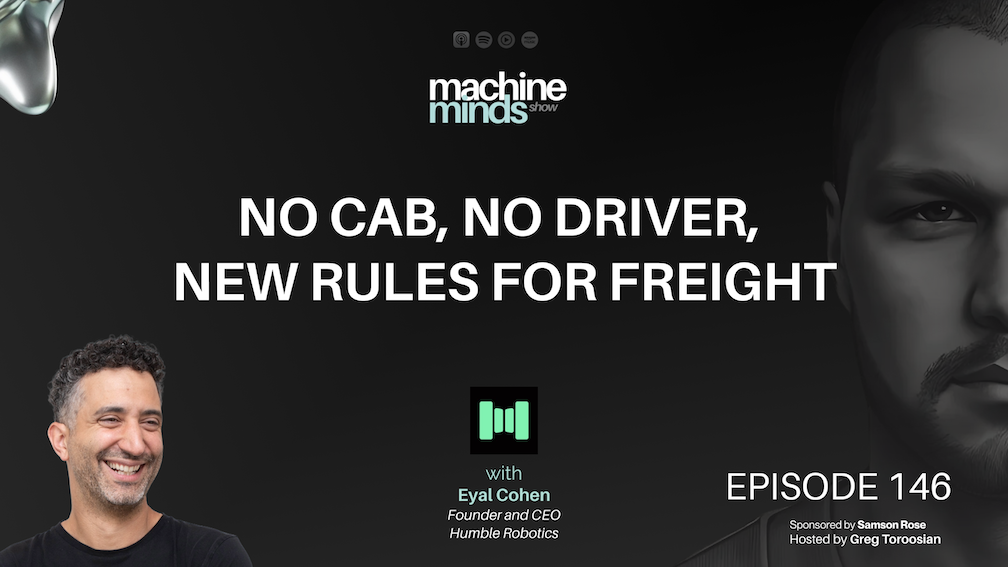
No Cab, No Driver, New Rules for Freight |
This week I sat down with Eyal Cohen, founder and CEO of Humble Robotics.
Eyal has spent more than two decades building electric and autonomous vehicle technology, including time inside Apple and Uber. He has watched several waves of this industry from the inside, and he came away convinced that the standard approach to autonomous freight, taking an existing truck and layering autonomy on top of it, is the wrong starting point.
His core argument: if nobody is sitting in the cab, the cab should not be there. Humble built a purpose-built electric freight platform instead, designed from the first sketch for a world where vehicles move dock to dock without a human on board. Removing the cab makes the vehicle far lighter than a conventional tractor and trailer, and that single decision cascades into cost, payload, and reliability. Some of what we covered: - Why Humble rejected traditional truck designs in favor of a purpose-built platform
-
What fully autonomous dock-to-dock movement would actually mean for supply chains
- How simplicity in the vehicle design unlocks gains in cost, payload capacity, reliability, and operational efficiency
- Why freight's labor problem is a long-term workforce shortage rather than imminent job displacement, and how autonomy fills the growing capacity gap
- How the team built its first vehicle at remarkable speed without loosening its safety and engineering standards
-
The dangers of premature scaling in hard tech, and why customer feedback should come before production volume
- Why patient investors who understand hardware timelines matter more than the size of the check
- Why culture, trust, and hiring exceptional people across every function beat technology alone
- Eyal's case for the return of moonshot engineering
- The hiring section is worth the listen on its own if you're building a team right now.
|
|
|
|
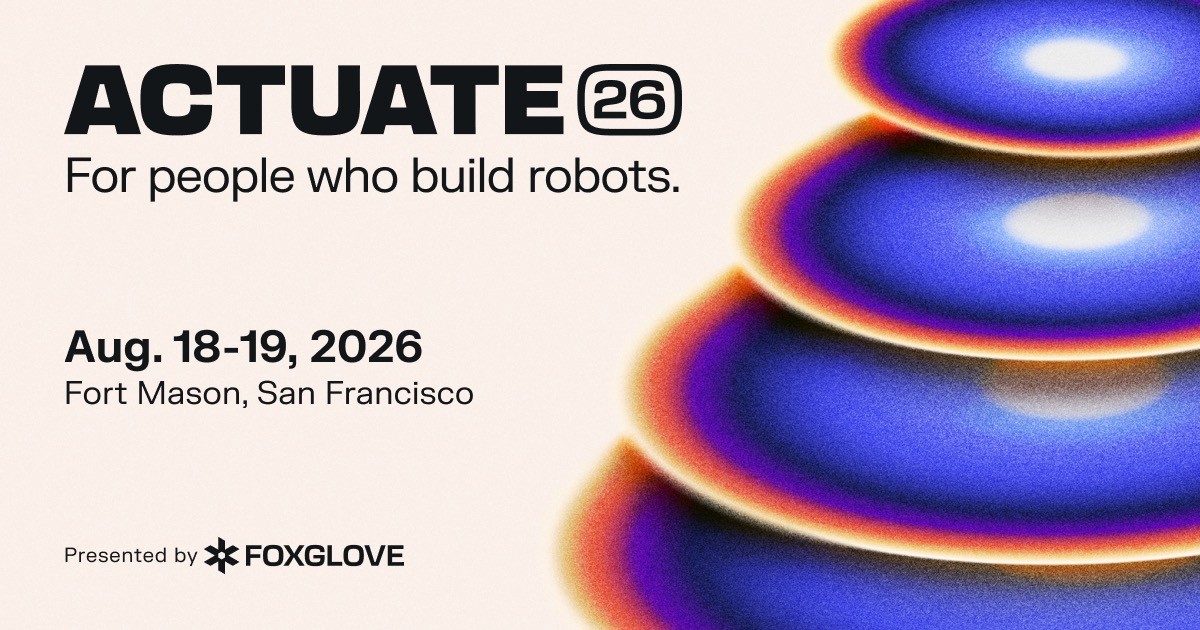
August 18 to 19 | Fort Mason, San Francisco Foxglove's annual developer conference for the people actually building robots. Two days and 40,000 square feet at the Gateway Pavilion, with a speaker list running from Alex Kendall (Wayve) and Chelsea Finn (Physical Intelligence) to Chris Urmson (Aurora), Sanja Fidler (NVIDIA), Carolina Parada (Google DeepMind), and Nathan Michael (Shield AI).
The framing is what makes it worth the trip. This is not a room for high-level industry stargazing. It's technical lessons learned building and scaling at the frontier of robotics, from warehouses to roads to the oceans and skies. Full Access passes are waitlist only at this point. Expo passes are still on sale.
Register here. |
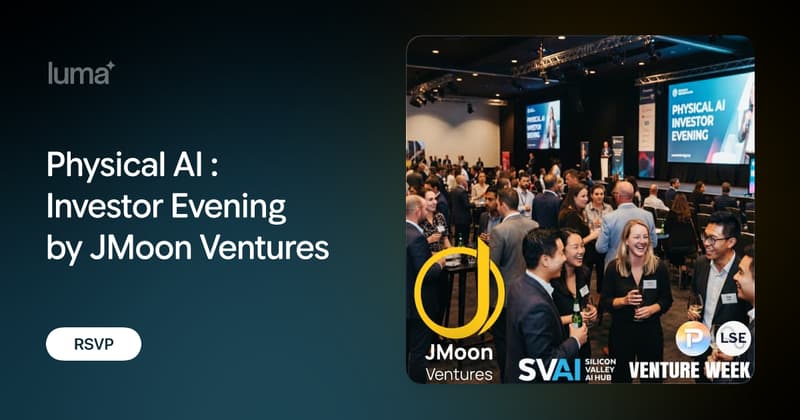
Physical AI: Investor Evening |
August 18, 5:00 to 8:00pm | Menlo Park If you sit on the investing side of this industry, this one runs the same evening as day one of Actuate. JMoon Ventures is hosting angels, GPs, fund allocators, family offices, funds of funds, and CVCs at the SVAI Hub for a session on venture exposure to AI-enabled hardware across robots, humanoids, IoT, XR, and wearables. Managing Partner Jasmeet, who coined the term Physical AI, opens with a primer on the category: how it differs from hardtech and deeptech, what is driving adoption, and how direct investors and allocators should think about getting exposure. A panel with Physical AI founders follows, then an hour of open networking.
Registration is subject to host approval. Request to join here. |
|
|
|
Three new searches we're running right now |
A few active searches that might be relevant to you or someone in your network:
Autonomous Driving System Safety Lead | San Francisco
One of the best-funded autonomous driving companies in the US, licensing its stack across multiple vehicle platforms. Highly visible individual contributor role owning the Autonomous Driving System safety case: authoring safety claims for onboard and offboard software, including the AI autonomy components, and coordinating the technical evidence behind them. Hands-on ISO 21448 (SOTIF) experience expected.
Integration & Test Engineer, Effector Systems | Los Angeles
Stealth defense company, only a couple of years old, more than $200M raised, founding team that has built billion-dollar companies before, and a commercial product with customers already signed. Hands-on integration, verification, and validation across next-generation air defense effector systems, from bench-level testing through full system execution.
Mechanical Design Project Leader | Middleton, MA
Global industrial automation company building advanced machinery and robotic systems for customers across multiple industries. Mechanical design paired with project leadership, carrying automation projects from concept through production, testing, and customer deployment.
Know someone? Reply to this email and send them our way. |
|
|
|
What we're reading this week |
Experts React to FCC Limits on U.S. Imports of Humanoid and Mobile Robots (The Robot Report)
The FCC added foreign-made humanoids and quadrupeds to its Covered List, citing supply chain and cybersecurity risk to critical infrastructure. Only new device models are blocked from authorization, existing ones are unaffected, and there is a conditional approval path. Read it for the operator and founder reactions rather than the wire summary. Worth holding next to Eyal's argument above for building hardware from the ground up rather than adapting what already exists. Kraken Technology Raises Series B Funding for Autonomous Vessels (The Robot Report)
The UK company builds uncrewed surface and subsurface vessels and has won contracts from the UK Ministry of Defence, NATO partners, and USSOCOM, with manufacturing partnerships including Rheinmetall and Anduril. Maritime remains one of the most under-invested corners of autonomy. Teradyne Robotics Revenue Rises 33% Year Over Year in Q2 (The Robot Report)
$100M in quarterly robotics revenue, US sales up to 32% of the total, and a new Michigan manufacturing center planned for later this year. A useful reminder that parts of this category are already a real business. |
|
|
|
Thanks for reading!
Don't want to receive these emails? There's an unsubscribe button at the bottom. |
Copyright Samson Rose 2026
27131 Calle Arroyo, Suite 1722, San Juan Capistrano, CA 92675 |
|
|
|
|