Hey, it's Greg
This week's episode goes somewhere you probably won't expect. Sára Nožková built AI that listens to wildlife, learns how they communicate, and responds in kind, deployed at airports, railways, and farms across two continents. What did you make of this one? Hit reply and let me know. I get back to every response. |
- Wildlife Whisperer: Inside the AI Built to Talk to Animals
-
Three searches we're running right now
- What we're reading this week
|
|
|
|
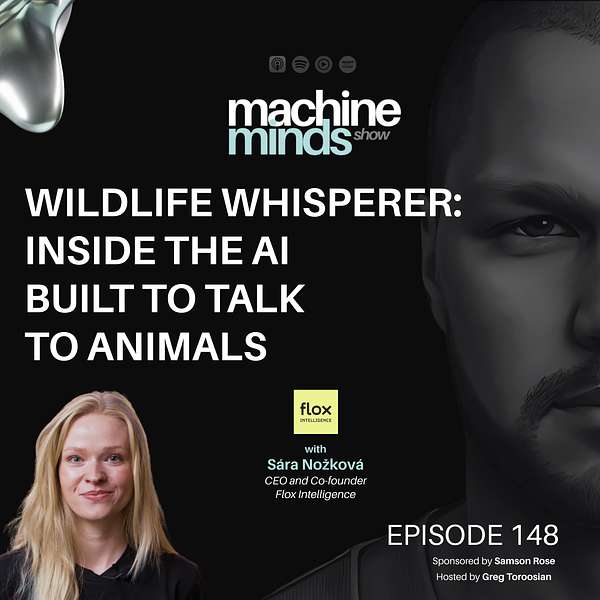
Wildlife Whisperer: Inside the AI Built to Talk to Animals |
Recently I sat down with Sára Nožková, CEO and co-founder of Flox Intelligence. Sára came to this from transportation research at KTH Royal Institute of Technology in Stockholm. The tools for keeping wildlife off runways, railway lines, and highways had barely changed in decades: pyrotechnics, fencing, loud noises. Expensive, unreliable, and often harmful to the animals. She started asking a different question: what if the technology listened first?
Flox builds what Sára calls a "Wildlife Brain." Their Edge devices combine computer vision, bioacoustics, and generative AI to detect, identify, and respond to more than 27 wildlife species. The system learns regional behaviors, dialects, and species-specific patterns over time, adjusting how it communicates based on what actually works with the animals in that specific area. A few things that stood out: -
Traditional deterrents fail because habituation sets in fast; an intelligent approach works by communicating on the animals' own terms
- The platform is deployed at airports, railways, farms, livestock operations, and transportation networks across Europe and North America
- Partners include WWF, Alstom, and transportation authorities, helping validate an entirely new category of wildlife technology
-
Deploying autonomous AI hardware in Arctic winters and Texas summers creates engineering challenges that lab testing simply does not prepare you for
- Sára scaled a deep tech company across two continents with a mission-driven team built around people who genuinely care about coexistence between wildlife and infrastructure
What makes this conversation stick is the ambition behind it. Building AI for wildlife communication is not the most obvious path from a transportation research lab, but the commercial case is real and the deployment evidence is growing. Worth the full listen. |
|
| |
Three searches we're running right now |
A few active searches that might be relevant to you or someone in your network:
VP, Robot Learning | San Francisco
An early-stage humanoid robotics company turning teleoperation into training data for autonomy. Executive role owning the robot learning roadmap from teleoperation data through learned policies to autonomous operation.
Photonics Scientist | Los Angeles
A well-funded hardware company building a foundry model for photonic sensing, first products in aerospace and defense. Senior role owning the optical and photonic architecture from analysis through prototype.
Head of Flight Test Engineer | San Francisco
An autonomous aviation company scaling its delivery platform globally. Leads flight test strategy and validation for next-gen autonomous aircraft, hands-on through release decisions. UAS experience preferred. Know someone? Reply to this email and send them our way. |
|
|
|
What we're reading this week |
HII Signs Up to $900M Agreement with Path Robotics and GrayMatter Robotics (The Robot Report)
Defense shipbuilder HII expanded its HYPER Program with AI-driven autonomous welding. Path Robotics' Obsidian physical AI model pairs with a mobile quadruped to bring welding beyond fixed cells, directly onto large assemblies in shipbuilding and heavy industry. One of the more consequential defense-meets-robotics contracts of the year.
Zoox Unveils Production-Ready Robotaxi for U.S. Expansion (The Robot Report)
Amazon's AV subsidiary moved from testing to production-ready hardware after a redesign for rider comfort. A useful benchmark for what "production-ready" actually means in autonomous vehicles and what the hardware-to-deployment gap looks like for a well-funded program.
Google DeepMind Says Gemini Robotics 2 Enables Full Body Control (The Robot Report)
DeepMind's updated robotics foundation model can reason through full-body movement, not just arm or hand tasks. If the deployment results hold, it shifts the complexity ceiling for what foundation models can handle in real-world robotic systems. |
|
|
|
Thanks for reading!
Don't want to receive these emails? There's an unsubscribe button at the bottom. |
Copyright Samson Rose 2026
27131 Calle Arroyo, Suite 1722, San Juan Capistrano, CA 92675 |
|
|
|
|