Hey, it's Greg
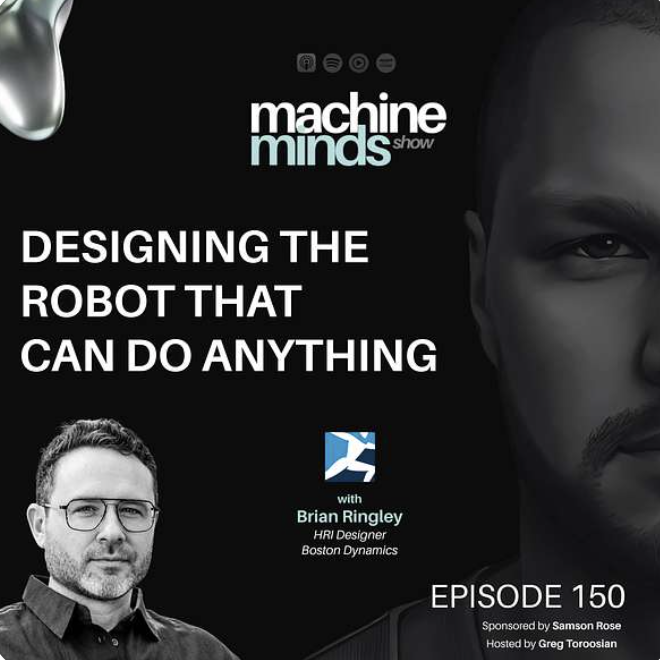
Episode 150. For this one I sat down with someone at Boston Dynamics who is answering a question nobody in robotics has had to answer before: how do you design the interaction model for a robot that could eventually do anything? That conversation is below, and it's one of my favorites. What would you ask the person designing how we'll work with humanoids? Hit reply. I get back to every one. |
- Designing the Robot That Can Do Anything with Brian Ringley
- Three searches we're running right now
- What we're reading this week
|
|
|
|
Designing the Robot That Can Do Anything with Brian Ringley |
I sat down with Brian Ringley, HRI Designer at Boston Dynamics, for the 150th episode of Machine Minds. Brian is the person figuring out how humans will actually interact with Atlas, a robot whose potential capabilities are essentially unbounded.
Brian's path is anything but conventional. He started in architecture, moved through CNC machining, industrial robotic arms, computational design, and construction technology before landing at Boston Dynamics. He first came on to explore construction applications for Spot, moved into product management and industrial inspection, and now leads human-robot interaction design for Atlas. A few things that stood out: -
The real product shift at Boston Dynamics. The company has moved from thinking of the robot as the product to treating the robot as an invisible physical layer that creates value through the work it enables.
-
Atlas presents a fundamentally new HRI challenge. When a robot can potentially be retasked through software to do thousands of different things, you cannot design a completely new application every time it learns a new task. The interaction model has to be as generalizable as the hardware.
-
The economic case for humanoids. Brian sees the real promise as one hardware platform that can be retasked through software, rather than requiring new machines for every application. That is a manufacturing and deployment economics argument as much as a technology one.
-
The Google DeepMind partnership matters. Frontier reasoning models and high-quality robotic hardware can accelerate each other. Brian gets into how reinforcement learning, behavior cloning, vision-language-action models, and traditional software tools work together across the Atlas autonomy stack.
-
The software-defined factory. Brian's vision is humanoids working alongside AMRs, fixed automation, inspection robots, digital twins, and other specialized machines, not replacing them.
Brian also shares why robotics consistently gets overestimated in the short term and underestimated in the long term. Building systems that can understand natural instructions, reason about unfamiliar situations, and operate reliably at scale remains extraordinarily difficult. But that difficulty is part of what makes the field so compelling. Worth the full listen if you are building, deploying, or investing in physical AI. |
|
|
|
Three searches we're running right now |
A few active searches that might be relevant to you or someone in your network:
Software/Robotics Design Engineer | Middleton, MA
A global industrial automation company building advanced robotic systems for customers across manufacturing, logistics, and warehousing. Hands-on role at their new Robotics Hub north of Boston, designing and implementing software automation for industrial machinery. You will prototype, build, and deploy in the lab with real hardware. Robot programming (FANUC, ABB, YASKAWA), PLC development, simulation, and digital twin work.
Manufacturing Engineer, Radar Systems | Los Angeles, CA
An advanced aerospace and defense technology company building sophisticated radar and electromechanical systems. Production-floor role supporting radar assembly, integration, and test operations. Troubleshooting, yield improvement, and process development as the company ramps toward higher production rates. U.S. citizenship and DoD clearance eligibility required. $110K to $160K base plus equity.
Radar Systems Engineer, Integration & Test | Hawthorne, CA
A rapidly growing defense technology company building advanced radar for real-world deployment. You will validate every radar that comes off the production line, working directly with RF test equipment and Python-based automated test systems. The team is building an increasingly automated test pipeline, and you will help shape it. $110K to $220K base plus equity. Relocation assistance available. Know someone? Reply to this email and send them our way. |
|
|
|
What we're reading this week |
Gravis Robotics raises $200M for autonomous construction (The Robot Report)
SoftBank-backed Series A for the ETH Zurich spinout that retrofits excavators and construction equipment with autonomy. Their Gravis Rack kit works across Caterpillar, Deere, Volvo, and more. Largest construction robotics round on record, and a signal that physical AI capital is moving into earthmoving and infrastructure.
What does Unitree Robotics' IPO mean for the humanoid industry? (The Robot Report)
Unitree has gone public, making it one of the first pure-play humanoid and quadruped robotics companies on a public exchange. The piece examines what this signals for the broader humanoid sector and which companies might follow.
Schaeffler plans to mass produce gearboxes for humanoid robots in 2027 (The Robot Report)
The components supplier is developing strain wave gearboxes using a forming technology designed for mass production, targeting the humanoid supply chain. A useful signal as the industry moves from prototype volumes toward real production scale. |
|
|
|
Thanks for reading!
Don't want to receive these emails? There's an unsubscribe button at the bottom. |
Copyright Samson Rose 2026
27131 Calle Arroyo, Suite 1722, San Juan Capistrano, CA 92675 |
|
|
|
|