Hey, it's Greg
This week's guest built something I think about a lot: a way to make factory automation accessible to manufacturers who were always told it wasn't worth the cost. That conversation is below. What's the biggest bottleneck you're seeing on the factory floor right now? Hit reply. I get back to every one. |
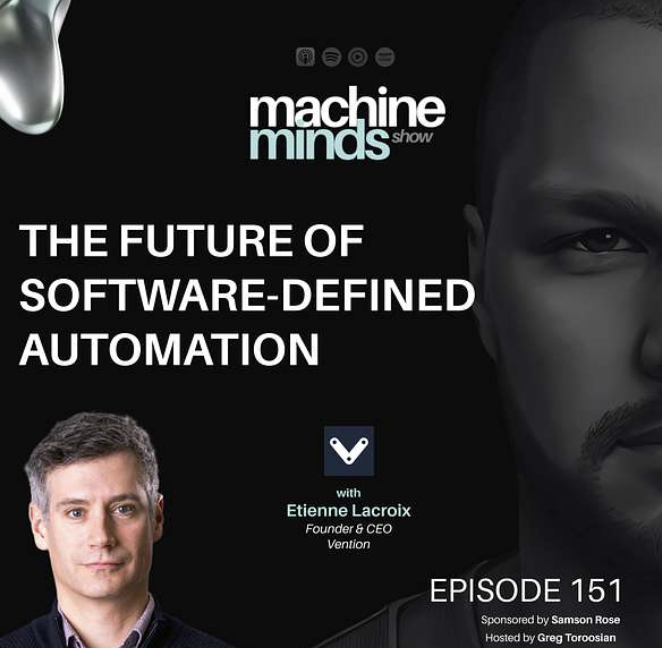
- The Future of Software-Defined Automation with Etienne Lacroix
-
Three searches we're running right now
- What we're reading this week
|
|
|
|
The Future of Software-Defined Automation with Etienne Lacroix |
I sat down with Etienne Lacroix, founder and CEO of Vention, for a conversation about what happens when you treat factory automation like a software problem instead of an integration project.
Etienne was designing machines and selling automation cells at 19 as a system integrator in Canada. What he saw up close was that roughly 40% of traditional automation costs come from engineering and integration. That realization became the foundation for Vention: a platform where manufacturers can design, simulate, program, order, deploy, and operate industrial equipment within a single connected digital workflow.
A few things that stood out: - His mental model for Vention is memorable. Think 3D design software combined with industrial Lego combined with Amazon Prime. Browser-based engineering-grade 3D design, modular hardware, and direct-to-door delivery.
- The deployment economics are real. Customers are averaging automation payback periods around 1.3 years, while cutting deployment timelines by three to six times.
-
A 300-motor conveyor system, largely vibe-coded, in about three weeks. The MachineMotion AI controller, built with NVIDIA technology, is bridging cloud-based digital twins and physical machines on the factory floor.
- Vention partners with UR and FANUC rather than building robot arms. The entire bet is on the deployment platform surrounding the hardware.
-
The industry is already moving beyond software-defined automation. Etienne sees the next phase as AI-defined automation, where application-specific field data matters more than the underlying foundation model.
Worth the full listen if you are building, deploying, or investing in factory automation. |
|
| |
Three searches we're running right now |
A few active searches that might be relevant to you or someone in your network:
Machine Learning Engineer | New York, NY
A high-growth, AI-forward consumer platform that has already reached millions of users. You will build and improve a RAG-based content recommendation pipeline with a push toward agentic, tool-calling behavior, train and deploy models directly, and design APIs that expose ML functionality to the rest of the product. 3+ years ML engineering experience, Python and FastAPI, hands-on fluency with modern LLM tooling.
Robotics Software Engineer | San Francisco, CA A climate-focused robotics startup building simulation and training infrastructure for autonomous systems. Hands-on role working across motion planning, perception, controls, and deployment.
Senior Optical Design Engineer | Los Angeles, CA
End-to-end ownership of critical optical subsystems on mission-critical defense and aerospace platforms, from first sketch and simulation through production hardware that actually flies. Laser-based and imaging systems, nanophotonics, metasurface design, or optical phased arrays. 9+ years, U.S. citizenship with clearance eligibility required. Know someone? Reply to this email and send them our way. |
|
|
|
What we're reading this week |
Gatik raises $200M Series D for autonomous middle-mile trucking (TechCrunch)
Led by Qatar Investment Authority and Koch Disruptive Technologies, this is Gatik's largest round to date. The company has completed 85,000+ fully driverless orders at a 99% on-time rate and locked in more than $600 million in contracted revenue from Walmart, PepsiCo, and Kroger. Targeting 100+ driverless trucks by end of 2026. A clear signal that middle-mile autonomy has moved past the pilot stage.
XPeng's Dogotix unit raises $900M at a $6.3B valuation (The Robot Report)
The largest single-round private financing in China's embodied AI sector. IDG Capital led, with Tencent and Alibaba as strategic investors. The IRON humanoid robot is expected to enter mass production by end of 2026, with commercial deliveries in 2027. Worth tracking alongside the broader humanoid investment wave.
Andreessen Horowitz raises $1.1B Machine Age Fund (TechCrunch)
a16z's first dedicated hardware-infrastructure vehicle. The fund backs chips, memory, networking, storage, data centers, robotics, and edge devices. Prior portfolio includes Anduril, SpaceX, and Skydio. When one of the most software-oriented VC firms in the world puts $1.1 billion behind physical infrastructure, it tells you where the AI buildout actually is. |
|
|
|
Thanks for reading!
Don't want to receive these emails? There's an unsubscribe button at the bottom. |
Copyright Samson Rose 2026
27131 Calle Arroyo, Suite 1722, San Juan Capistrano, CA 92675 |
|
|
|
|